Most people feel like they’re doing the right thing.
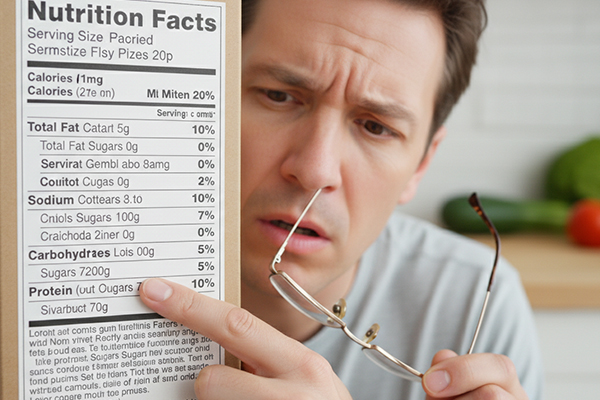
They flip the package over.
Check the calories.
Check the sugar.
Maybe glance at protein.
And if it looks reasonable?
👉 Good enough.
But here’s the uncomfortable truth more people are starting to realize:
Nutrition labels don’t always tell you how your body will actually respond to that food.
They flip the package over.
Check the calories.
Check the sugar.
Maybe glance at protein.
And if it looks reasonable?
👉 Good enough.
But here’s the uncomfortable truth more people are starting to realize:
Nutrition labels don’t always tell you how your body will actually respond to that food.
Labels show numbers—not outcomes
Nutrition labels are built around data:
- calories
- grams of fat
- grams of carbs
- grams of sugar
But your body doesn’t experience food as numbers.
It experiences:
It experiences:
- energy
- fullness
- cravings
- focus
And those don’t always match what the label suggests.
Where things get misleading (without being “wrong”)
The label isn’t lying.
But it’s incomplete.
Because it doesn’t show:
But it’s incomplete.
Because it doesn’t show:
- how quickly something affects your energy
- how your body processes it
- how long it actually keeps you satisfied
Two foods can have:
👉 the same calories
👉 the same carbs
And produce completely different experiences.
One keeps you full and steady.
The other leaves you:
👉 the same calories
👉 the same carbs
And produce completely different experiences.
One keeps you full and steady.
The other leaves you:
- hungry again
- low energy
- craving more
Same label.
Different result.
Different result.
The ingredient list is where the real story is
Most people spend 5 seconds on the label…
And ignore the one section that matters most:
👉 Ingredients
And ignore the one section that matters most:
👉 Ingredients
Here’s a simple rule that changes everything:
👉 If you can’t recognize at least 70–80% of the ingredients, your body probably has to work harder to process it.
👉 If you can’t recognize at least 70–80% of the ingredients, your body probably has to work harder to process it.
That doesn’t mean it’s “bad.”
But it does mean:
👉 It’s more complex for your system to handle.
But it does mean:
👉 It’s more complex for your system to handle.
A quick trick almost nobody uses
Next time you’re comparing two products, try this:
👉 Don’t look at calories first.
👉 Look at the ingredient count.
👉 Don’t look at calories first.
👉 Look at the ingredient count.
Example:
- Product A: 25 ingredients
- Product B: 6 ingredients
All else equal?
The simpler one is usually easier for your body to process.
It’s a small shift—but it changes how you shop instantly.
The simpler one is usually easier for your body to process.
It’s a small shift—but it changes how you shop instantly.
Why this matters more than people think
Because over time, people don’t just eat one product.
They build habits.
And those habits stack daily.
So the question becomes:
They build habits.
And those habits stack daily.
So the question becomes:
- Are you consistently eating foods your body handles smoothly?
- Or foods that feel “fine” on paper… but leave you off afterward?
The takeaway people don’t expect
Nutrition labels are helpful.
But they’re not the full picture.
Because the real question isn’t:
👉 “What does this say on the label?”
It’s:
👉 “How does my body actually respond to this?”
But they’re not the full picture.
Because the real question isn’t:
👉 “What does this say on the label?”
It’s:
👉 “How does my body actually respond to this?”
Once people start paying attention to that…
They stop relying only on numbers.
And start trusting patterns.
And that’s where smarter decisions start happening—without needing extreme diets or complicated rules.
They stop relying only on numbers.
And start trusting patterns.
And that’s where smarter decisions start happening—without needing extreme diets or complicated rules.